



Ghana’s Women Hawkers: Survival vs. Safety
Conversation.
Women street hawkers in Ghana
In a world where everyone must survive, there must be various ways people find work that can sustain them.
People find themselves in different job opportunities to ensure that they don’t lack what to eat, what to wear, and what to sleep.
One major problem in Africa(Ghana) is employment, so it’s prudent to find what is suitable for your survival.
When it comes to job findings everyone understands their level of what they can do.
For instance, an uneducated person understands that since they didn’t get the ability or sometimes the resources to complete a formal education, the best thing for them to do to survive is to find work that does not involve writing or speaking English, which is the official language in Ghana.
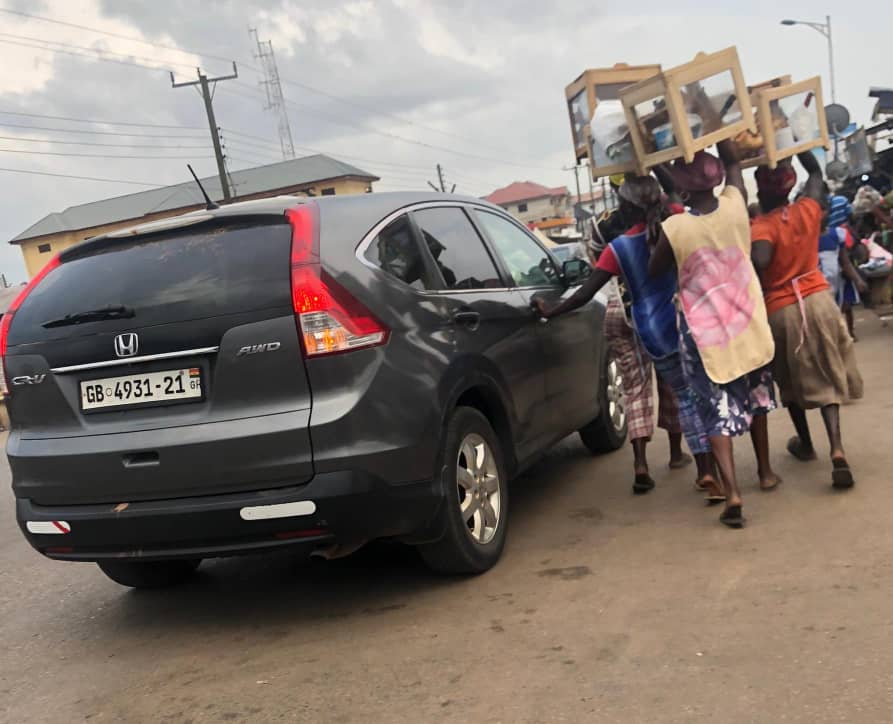
Now, my focus today is on African women who sell on the street at transport stations.
Their work is best described as street hawking. Their work, which I believe is a typical marketing strategy, also poses a danger to their human safety. But do they care?
The purpose of their target market is passengers in transport buses and those in their private cars.
People driving from a long journey might be hungry and would buy from them, those who failed to eat at home while travelling would probably buy something to eat along their journey, those who set out from home at dawn would also want to buy something to eat along their journey, someone on medication would also want to eat along their journey if it’s time to take their medicines.
In fact, their selling strategy is to solve a problem and it’s indeed solving a problem.
Many times, we hear about road traffic accidents that result in the deaths of street hawkers.
We can fully blame lack of job opportunities for those who lack formal education. They see this work as a perfect work opportunity for their survival.
The most painful aspect of this nature of work is that, young adults have been forced by their parents to indulge in this unqualified kind of work.
Also young adults who feels a formal education was not meant for them also see this kind of work as a perfect job for their survival.
But the question remains, “Are street hawkers safe in their field of work?
Between Survival and Safety: The Reality of Women Street Hawkers in Ghana
In a world driven by the fundamental instinct to survive, the quest for sustenance determines the path many take. Regardless of geography, the goal remains the same: to secure food, clothing, and shelter.
However, in Ghana, where unemployment remains a significant challenge, the definition of “work” often adapts to necessity. For many, particularly those without access to formal education or the resources to bridge the language gap of business English, the formal job market is a closed door.
Instead, they turn to the streets. Today, we look specifically at the women street hawkers stationed at transport terminals and highways—a demographic balancing on the razor’s edge between economic survival and physical danger.
The Informal Economy: Making Do With What You Have
For those who missed the opportunity for formal schooling, understanding one’s limitations is key to finding a viable livelihood. In Ghana, where office jobs require literacy and fluency in the official language, the uneducated often look for trade opportunities that rely on grit rather than grammar.
This has given rise to the ubiquitous culture of street hawking. While it may look chaotic to the untrained eye, it is, in reality, a distinct marketing strategy borne of necessity.
The Strategy: Solving Problems on the Go
The target market for these women is precise: passengers.
Whether they are in commercial buses (tro-tros) or private vehicles, travelers represent a captive audience with immediate needs. The hawkers identify gaps in the traveler’s journey and fill them instantly.
Consider the needs of the average traveler:
The Long-Distance Traveler: Exhausted and hungry from hours on the road.
The Early Riser: Those who left home at dawn without breakfast.
The Commuter on Medication: Passengers who need food quickly to take scheduled medicine.
By positioning themselves in traffic and at stations, these women are not just begging for sales; they are solving a problem. They provide convenience and nourishment exactly when and where it is needed.
The High Cost of Survival
Despite the logic behind the trade, the environment is hostile. The workspace for these women is often the middle of a highway or a bustling, unpredictable transport yard.
- The Safety Risk
The most glaring issue is physical safety. It is unfortunately common to hear of road traffic accidents involving hawkers weaving between moving vehicles. The proximity to speeding metal makes this one of the most dangerous unorganized professions in the country. - The Generational Cycle
Perhaps the most painful aspect of this industry is the involvement of the youth.
Forced Participation: Many young adults are pushed into hawking by parents out of financial desperation.
The Dropout Effect: Others, feeling that formal education offers them no clear path, drop out to join the trade, perpetuating a cycle of low-income, high-risk labor.
Conclusion: A Question of Worth
We can attribute the prevalence of street hawking to a lack of formal job opportunities and the sheer will to survive. These women (and children) have identified a gap in the market and are filling it with immense tenacity.
However, as we buy a bottle of water or a snack through a car window, we must confront the lingering reality of their situation. It brings us to a critical, unanswered question:
Is the ability to survive worth the constant risk to life?
Until safer economic alternatives are created for the uneducated and under-resourced, the streets of Ghana will remain both a marketplace and a hazard zone.